
A practical guide to improving road safety in 10 steps.
Roads remain the biggest killer of people aged 5-29, and 92% of road deaths occur in low and middle-income countries.

TLDR - This article provides an overview of the steps required to enhance road safety within your organisation. It will be most relevant to leaders or practitioners overseeing vehicle fleets in countries with a poor road safety record.
It covers 10 steps: baselining, leadership engagement, regulation, operationalisation, engaging drivers, rentals, end-user feedback, prioritising investigation, running campaigns and rebaselining.
To support this newsletter, please like, comment or subscribe to the content, AND please share this with one person that you think may benefit from it.
Introduction
Humanitarian supply chains rely on a vehicle fleet to transport cargo and personnel in countries where governments have not effectively legislated to promote a positive road safety culture. This means humanitarian fleets operate in areas where the physical infrastructure is poor, the enforcement of road safety controls is neglected, and the culture of road safety is emerging. This leads, tragically, to unnecessary road deaths.
In contexts where national road safety culture is still developing, organisations must take the lead in cultivating their own. This is not easy, as it requires challenging established norms. It also means that an organisation can have an out-sized impact on reducing the risk of a fatal road traffic incident by filling the gap left by ineffective legislation.
1. Understand your baseline and how it compares to safe
For a simple rough baseline of how your organisation is doing, you can use this article, take the key points in each “what I’d expect to see section, and put a tick or cross next to your current practices. This will give you a good indication of what may be missing.
For more in-depth reading, I’d recommend going through some of the available WHO resources to understand the current state of road safety in your country.
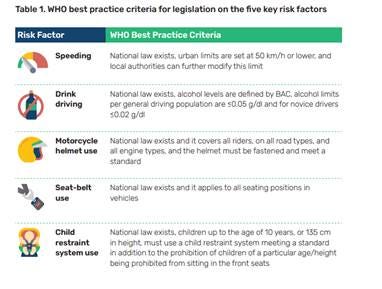
This report covers the WHO updates on global road safety progress - the image below shows the five key areas that WHO recommends legislation for, and the map below shows which countries have implemented the recommendations.
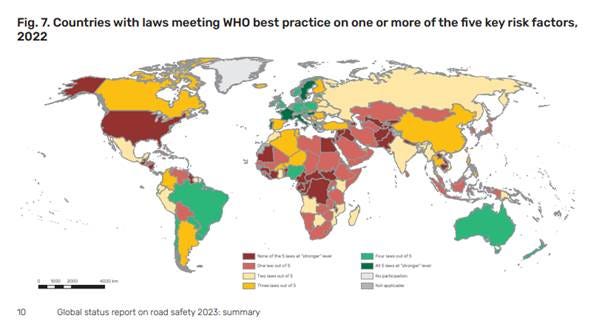
If you are in one of the 54 countries that have no laws meeting the WHO best practice guidance, then it is possible that the road safety culture you’ve emerged in is not safe. This may mean that your established norms are not safe, and reading and researching what constitutes good road safety practice should be your first step.
Reading the WHO technical road safety package is recommended – note that this document is written as if addressing the government to act, so it needs to be adapted to the organisation’s context. WHO Technical Road Safety Package
I’d expect to see
· An assessment of road safety practices in your country and organisation vs best practice
· An action plan for how to improve (see below some likely initiatives)
2. Develop leadership engagement from the very top
To start culture change, leaders must lead. Road Safety must be a priority for senior leadership, and this must be visible to staff.
I’d expect to see
· Consistent communication on what is expected of staff on road safety standards.
· Leadership intervention to fund high-impact initiatives (for example, vehicle telematics).
· Leadership challenging unsafe behaviour and implementing consequence management in the event of policy violation.
3. There must be a regulation or policy that sets the standard
For leaders to lead effectively, there must be a clear policy that sets the standards for the organisation to meet. The document sets out the expected standards for the organisation.
The policy must be clear, concise, and effectively communicated to employees. This provides a standard for the organisation to achieve and enables consequence management if the policy is not met.
I’d expect to see;
· A road safety policy that outlines the governance for road safety and covers critical areas of road safety management
o Use of vehicles
o Vehicle standards
o Seatbelt use
o Telematics use
o Speed limits
o Licensing and training rules for drivers
o Driver breaks and journey management standards
o Incident reporting
4. Operations/Supply Chain must prioritise Road Safety
In most organisations, operations or supply chain oversee Fleet, and as the function that operates the fleet, it must have road safety at the core of its operations.
I’d expect to see
· A clear set of procedures for managing fleet safely (how to operationalise the policy)
· An induction document for drivers about how to safely operate the fleet, including all the organisational standards
· Vehicles being tracked using telematics (hardcore VTS systems or simpler mobile phone applications)
· Bi-weekly meetings with drivers to discuss safety, policy implementation and vehicle tracking alerts
· Speed limits are clearly set and any gaps (e.g. no national speed limit for urban areas) are closed.
5. Driver engagement and training
This can often be the “go-to” intervention to improve road safety. It is important, but without challenging and enhancing the culture, the impact of driver training will not be maximised. So this step is important, but don’t do it without the other steps.
I’d expect to see
- Driver workshops bi-weekly to discuss challenges, telematics feedback, security context.
- Driver feedback mechanism (anonymous if needed)
- Training curriculum for drivers based on vehicle type and terrain
6. The organisation must not forget about rental vehicles
In general, organisations focus first on their own fleet. However, if you also rent vehicles externally to augment your owned fleet, then this group of vehicles requires a dedicated focus to ensure that risks are effectively managed.
I’d expect to see
- Specific agreements that outline responsibilities between your organisation and the rental company
- Flowing down as many of your own policies to the rental company as possible
- Procedures in place to check the vehicles being supplied and to avoid substitution
- Double checks in place on licensing and training of drivers.
7. End users must have a simple feedback mechanism to report unsafe behaviour
Passengers are the end-users of your Fleet and must be given a way to report unsafe behaviour in the running of the Fleet. It is highly likely that, before an incident occurs, multiple examples of policy violations or unsafe driving will have already occurred. If the road safety culture encourages effective flagging of dangerous behaviour early, then it is possible to intervene before anything happens.
I’d expect to see
· A clear mechanism for reporting unsafe driving behaviour that is digital and accountable
· Independent oversight of the follow-up and resolution of the reports.
8. Investigation is prioritised
Investigating incidents when they occur is critical to enabling consequence management and organisational learning. Serious incidents must be investigated by someone who is not involved in the day-to-day management of Fleet. This is sensitive work that involves liaising with internal or external survivors, community groups, and local authorities.
I’d expect to see
· Guidelines on how to investigate road traffic incidents
· Templates that encourage getting to the root cause of incidents
· Clear consequence management (for example, disciplinary action for violating policy)
· After-action review sharing to encourage organisational learning.
9. Internal communications and marketing must promote safe road behaviours
To establish a strong road safety culture, considerable effort must be made to keep road safety at the forefront of all staff’s agendas. Organisations must consider innovative ways to achieve this.
I’d expect to see
- Rewarding safe driving by rewarding your safest drivers or fleet managers
- Poster campaigns promoting the use of road safety
- Regular campaigns to keep road safety high on the agenda, including campaigns related to specific areas such as seatbelt use or speed management.
10. Re-baselining every 2-3 years and creating a new action plan
Complex change, such as improving road safety culture, takes time. Organisations must regularly take stock of progress, celebrate achievements and develop updated plans to continue to deliver improvements.
I’d expect to see
- Re-assessment of progress, an updated baseline and a plan of action for the next two years.
Conclusion
In my experience, a significant amount can be achieved in road safety with a small number of passionate and dedicated individuals. The investment in road safety is not only morally the right thing to do, but it has been proven many times over to repay any investment that is given in it. Humanitarian organisations must prioritise road safety to minimise the negative impact we do in the world and effectively safeguard staff and communities.
If you have found success with interventions not mentioned in this article, please write them in the comments or message me.
Excellent and much-needed piece, Jamie. The 10-step approach provides a very practical roadmap especially in contexts where formal road safety systems are weak or underdeveloped.
I particularly appreciated your emphasis on leadership engagement and continuous re-baselining — too often, initiatives lose momentum after initial rollout. One area that might further strengthen this framework is integrating community and local government partnerships within the process. These collaborations can help reinforce organisational efforts with external accountability and shared learning.
This is an incredibly helpful guide that could be easily turned into an organization’s procedure manual. Such an important topic that will save lives.