
Working with Amazon on disaster response
and how they like to sit in silence during meetings.

Amazon CEO Andy Jassy launched Amazon Supply Chain Services this week, posting on LinkedIn…
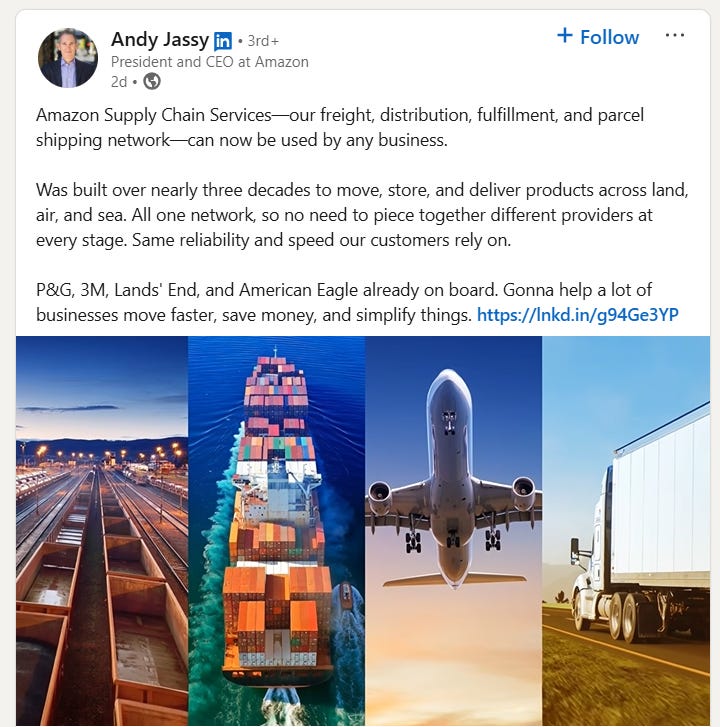
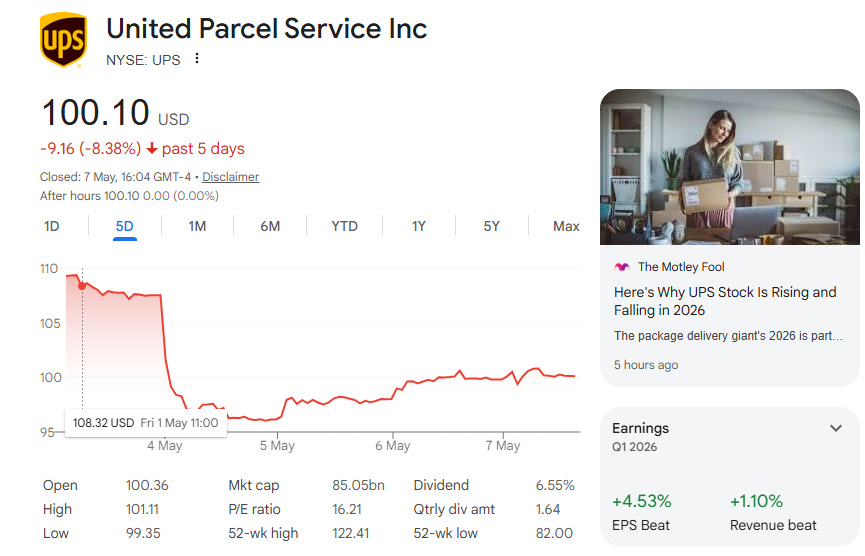
This pits Amazon against established large-scale logistics service providers. The result in UPS’ share price was pretty immediate
This news prompted me to reflect on the work I did leading our collaboration with Amazon during the early stage response to the Ukraine crisis. Amazon did many incredible things for us during that response, but getting off the ground was challenging and an interesting clash of cultures.
March 2022
When I was deployed to Ukraine at the start of the war with Russia, we had a lot of corporations trying to support the response. Support came in many different forms. Some offered expertise, products or services, others provided cash. Working out which offers were genuinely valuable and which were false economies became an everyday occurrence.
I’m not exaggerating when I say we were getting daily offers of goods and services, to the point where we had to put a specific structure in place to rapidly assess each one and respond quickly.
We ended up with furniture from IKEA, cars from Volvo, toys from Hasbro, consulting support from PwC, office space from a co-working company and much more. During that initial response, the engagement with Amazon was probably the most challenging and significant.
So, what did Amazon do for us?
There were many strands to the relationship with Amazon, but the primary one was that they published a product list on their website, including hygiene items and shelter materials, based on a needs assessment of displaced communities. Members of the public then purchased these products on Amazon.co.uk, but instead of shipping them to their own homes, the products were shipped to a distribution centre in Poland called KTW1 (all Amazon locations have a unique code).
Once sufficient volumes had built up for onward distribution, Amazon would move the products to the border with Ukraine (sometimes via Romania). They could not cross into Ukraine themselves, so we would then take custody of the goods and transport them onwards to locations hosting internally displaced families. We moved a huge amount of relief items this way, and it was set up in a matter of weeks.
This worked really well for several reasons.
Amazon already had infrastructure that could be leveraged and repurposed for humanitarian response.
Amazon had strong truck and rail freight links running from Western to Eastern Europe that could be utilised for these products.
Amazon had strong brand awareness and high customer volume, meaning people purchased products in large numbers.
There were also several drawbacks.
Although the products listed on Amazon.co.uk were based on community needs assessments, the final volumes and product mix purchased were ultimately determined by Amazon customers. People were far more likely to buy nappies/ diapers than blankets for adult men, leading to an oversupply of nappies and diapers and an undersupply of blankets.
Amazon took a long time to realise that we could not forecast delivery timelines in the same way they could. Once products arrived at KTW1, there was immediate pressure to move them to communities, but that took time. Amazon’s entire system is built around inventory flowing quickly through infrastructure.
People reading this now might say, “But you should have bought locally in Ukraine to support businesses”. Unfortunately, at that stage, the private sector was decimated. Shops were empty, supply lines were cut, and the only realistic option was to procure items in Europe and move them across the border into Ukraine. For that early phase of the response, it made sense, and it filled a critical gap.
This supply line was scaled up just weeks after the war started and operated really effectively in those first months.
I was genuinely impressed by Amazon's ingenuity in solving other problems.
When we heard from communities that children needed Ukrainian-language books for child-friendly spaces and for the bunkers they were sheltering in, we raised this with Amazon. Amazon explained that it had a large book-printing capacity that could produce thousands of books per day if it could identify books without rights restrictions that were in its product catalogue.
That’s how I ended up in a phone call with a publisher negotiating a temporary rights exemption for some back-catalogue items to allow Amazon to print them and give us the book. Amazon then printed books and shipped them directly to us.
Overall, Amazon and SCI scaled up a response to meet the enormous unmet needs of millions of refugees and internally displaced people - this didn’t provide long-term solutions, but I’m certain it made the days and months they spent in temporary shelters more comfortable.
The entire culture of the people we engaged with at Amazon was very much that no problem was too difficult to solve, people took ownership, followed up on actions and drove things forward.
When two different worlds collide, amusing things can happen
That being said, there was also an amusing cultural clash around a few areas.
I believe PowerPoint is effectively banned at Amazon. Instead, before meetings, you produce a written concept note outlining the decision to be made. The note is attached to the meeting invite.
As I normally would, I read the document beforehand and made notes. When the meeting opened, all the SCI people were ready to go with questions and debate. The Amazon people, however, started reading the document silently whilst everyone sat on the call.
When this approach hasn't been explained to you, and it suddenly happens, it genuinely feels like you are in another world. As someone who struggles to sit in silence at the best of times, doing it with 10 people on a call was one of the longest 10 minutes of my life.
After about 3 minutes, I cracked, “Don’t you guys read the doc in advance?”
This is apparently completely normal at Amazon and was explained to me as a way of avoiding people pretending they had read documents and then making poor decisions.
For the following meetings, I dove into the Amazon way and sat there in horrific silence, reading the doc with others. The Amazon folks went off camera, but I kept mine on as if to share my visual discomfort with everyone.
As our relationship with Amazon grew, we collaborated with them to fund supply chain training courses that are still available on the Disaster Ready platform. Check them out if you haven’t done them already.
As part of this arrangement, we had access to a panel of Amazon experts who reviewed our training materials and improved them.
There were a number of senior Amazon technical experts on the call, and they picked up on a photo in our training showing a warehouse built on stilts to avoid flooding during the rainy season. The Amazon team could not get their heads around the fact that, in humanitarian response, you do not get to choose the optimum staging post for a slick country logistics operation, but you have to put stuff near where it is needed.
They were concerned that if we kept the picture in, then everyone would put their warehouses on stilts. We assured them our teams only do that in extreme circumstances.
I also had to chuckle when one of my team members started explaining network optimisation to one of the most senior Amazon supply chain professionals we’d engaged with. To be fair to him, he smiled, took it well, and thanked us for our input.
More collaboration like this is needed
Amazon continues to develop its disaster relief operations, led by Abe Diaz, with whom I collaborated on the Ukraine response. You can read more about this and Abe at the link below: Amazon Disaster Relief.
The more actors trying to solve the world's biggest challenges, the better. As Amazon Supply Chain Services develops and expands into more locations that receive international humanitarian aid, I’m sure they will leverage this capability to enhance Amazon Disaster Relief.
Corporations in general should donate money to support people, communities, or programmes, but the next best thing is to use their expertise and unique value propositions to support.
Thanks to the many Amazon staff I worked with on that response, including Nikki, Rel, Abe, Pablo, Charlie and all the warehouse teams.
Great recap of an interesting experiment!